

Written by Scott Dunnicliff.
A camera, a radio and a navigation display can each pass a bench test and still fail together on the boat. Voltage dips under load. Interfaces do not match. Mounting positions block sightlines. Nobody documented the wiring. A systems integrator must establish the electrical, data, physical and operator picture before installation begins. This guide lists what to inspect, measure, document and demonstrate.
Key Takeaways
- Require an installed-condition survey before any quotation is final.
- Require measured voltage under load, not nameplate figures alone.
- Require interface diagrams that assign responsibility for every connection.
- Require an installation approach that protects against water, corrosion and vibration.
- Confirm the crew can operate the system with intended gear.
- Define acceptance tests and handover documents before work starts.
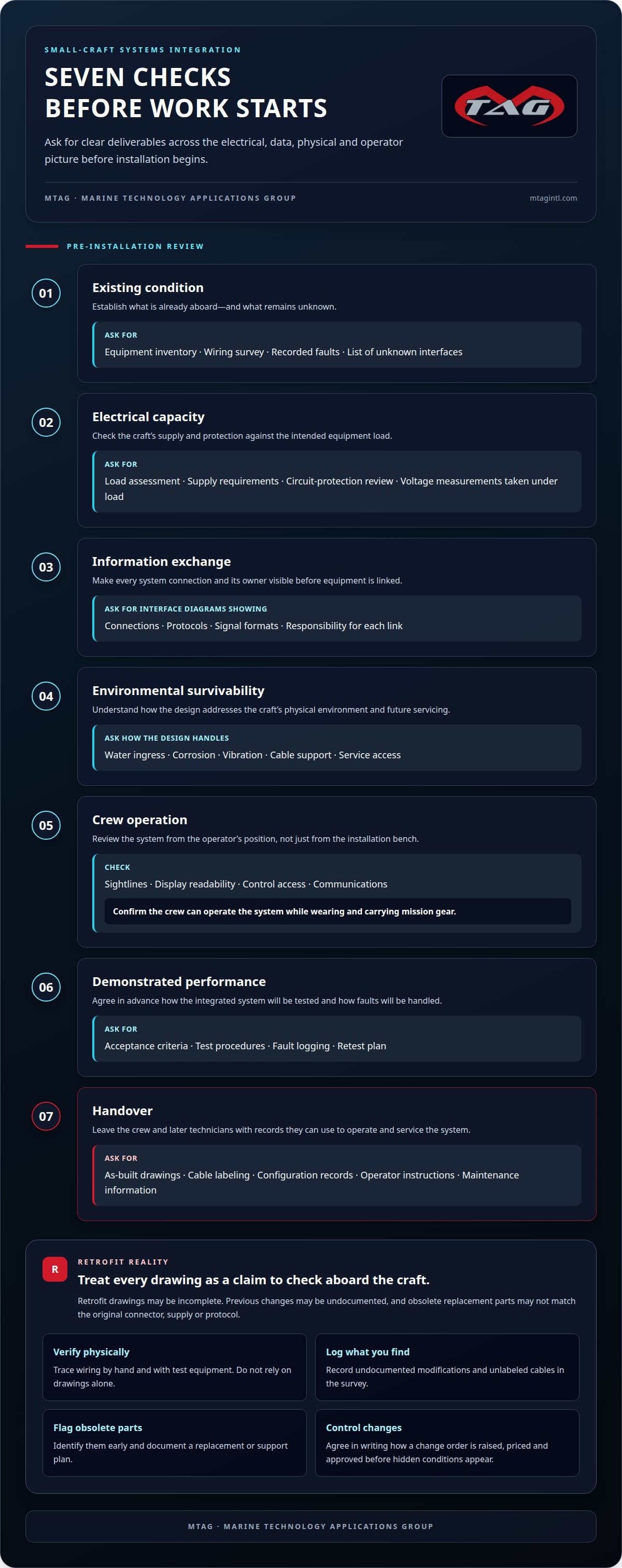
Seven checks before work starts
Ask the integrator for each deliverable below. A clear answer shows how the work will be run. A vague answer shows where the risk sits.
- Existing condition. Ask: "How will you establish the craft's existing condition?" Request an equipment inventory, a wiring survey, recorded faults and identification of unknown interfaces.
- Electrical capacity. Ask: "How will you assess electrical capacity?" Request a load assessment, equipment supply requirements, a circuit-protection review and voltage measurements under relevant loads.
- Information exchange. Ask: "How will equipment exchange information?" Request an interface diagram identifying connections, protocols, signal formats and responsibility for each interface.
- Environmental survivability. Ask: "Can the installation survive its operating environment?" Request an installation approach addressing water exposure, corrosion, vibration, cable support and service access.
- Crew operation. Ask: "Can the crew operate it effectively?" Request a review of sightlines, display readability, control access, communications and operation while wearing intended equipment.
- Demonstrated performance. Ask: "How will you demonstrate that it works?" Request agreed acceptance criteria, representative test procedures, fault records and corrective-action retests.
- Handover. Ask: "What will we receive at handover?" Request as-built drawings, cable labels, configuration records, operator instructions and maintenance information.
Why the survey comes first
Every later check depends on the survey. Load figures mean little if unknown equipment draws from the same bus. An interface diagram is incomplete if cables were added and never recorded. The survey fixes the baseline that power, data and mounting decisions build on.
Ask who will perform it, how many hours aboard the craft it needs, and what the integrator will hand back. The output should be a written record, not a verbal summary.
Why measurement beats nameplate figures
A nameplate states what a device is rated to draw. It does not show what the bus delivers when engines, pumps, radios and sensors run together. Measured voltage under relevant loads shows whether the camera resets when another system starts. Ask for the readings, the conditions and the loads active at the time.
Retrofit realities
Retrofit drawings are often incomplete. Previous crews add equipment and leave no record. Parts go obsolete, and a replacement may not match the original connector, supply or protocol. Treat every drawing as a claim to be checked aboard the craft.
- Verify installed wiring. Trace wiring by hand and with test equipment. Do not rely on the drawing set alone.
- Record discoveries. Log undocumented modifications and unlabeled cables in the survey, with location and apparent function.
- Flag obsolete components. Identify them early, with a replacement or support plan.
- Control scope changes. Agree in writing how a change is raised, priced and approved before hidden conditions appear.
Ask the integrator for an example of how it recorded a surprise on an earlier craft and how the customer approved the change. The answer shows whether the process exists.
New builds differ. Integration can be coordinated with the vessel design, so the review shifts to how interfaces, cable routes and equipment locations were decided with the design team. Ask to see those decisions written down.
Hypothetical retrofit example: adding an EO/IR camera
This is an illustration only. It is not a documented project and it is not an MTAG project. It states no specifications.
A crew wants an EO/IR camera on a craft with existing consoles. A sound integrator works through these steps. Each step raises a question and exposes a dependency.
- Power assessment. Inventory current loads. Measure bus voltage under load. Review circuit protection. Confirm the camera supply requirement against what the craft can deliver, including when other systems run at the same time. If the margin is thin, the power work must precede the mounting work.
- Mounting. Choose a location with a clear field of view. Check vibration exposure, water ingress paths, cable support and service access, so the unit can be reached for maintenance without removing other equipment.
- Video and data compatibility. Document the camera output format and control protocol. Confirm the network and display accept them. Assign responsibility for each connection on the interface diagram.
- Operator display. Place the feed where the operator can read it without losing navigation information. Confirm control access from the operating position.
- Acceptance testing. Run the written procedure under power load and underway conditions. Log faults. Retest after each correction and record the result.
Note the order. The mounting position depends on cable routes. The display depends on the video format. Acceptance depends on all of them. An integrator who cannot explain these dependencies has not planned the job.
What a quotation should contain
Compare quotations by scope, not by total. A complete quotation separates these lines:
- Survey
- Engineering
- Hardware
- Installation
- Testing
- Documentation
- Training
- Travel
- Stated assumptions about existing equipment
A low total often hides a narrow scope. Check what is excluded and how changes are handled. If the quotation assumes existing wiring is sound, ask what happens when the survey shows otherwise. For more on trade-offs, read Small Craft Mission System Architecture: Cost and Risk Trade-offs.
Acceptance testing and handover
Agree acceptance criteria before work starts. Each criterion should state what is tested, under what load, and what counts as a pass. Tests should represent real use: power load applied, systems running together, and the craft underway where the mission requires it.
Faults found during testing go into a record. Each correction is retested, and the result is logged. At handover, the crew and later technicians need the documents to sustain the system:
- As-built drawings that match the craft
- Cable labels that match the drawings
- Configuration records for every networked device
- Operator instructions written for the crew
- Maintenance information for routine service and troubleshooting
Applicable registration, cybersecurity, information-handling, and technical requirements must be established from the specific solicitation, contract, and project scope.
Frequently Asked Questions
What should an integrator have before a survey?
Provide existing drawings, the equipment list, known fault history and the intended mission use. Expect the integrator to treat these as unverified until checked aboard, and to use them to plan the survey and its time on the craft.
How should undocumented wiring be handled?
Trace it physically, label it and record it in the survey. Add it to the interface diagram so the connection has a named owner. Agree how any resulting change is approved before work continues.
What should acceptance testing prove?
It should prove that the integrated system meets written criteria under load and in use, not just on the bench. Faults are logged, corrected and retested, and the results are recorded for handover.
What documents should come at handover?
As-built drawings, cable labeling, configuration records, operator instructions and maintenance information, so the crew and later technicians can operate and service the system.
Discuss your craft
MTAG, Marine Technology Applications Group, integrates mission systems for military small craft, connecting sensors, networks, power and command-and-control. To discuss your craft, its existing configuration and your integration requirement, see MTAG Maritime Systems Integration.
